Welcome to the Playroom! It's 2026.
Happy New Year! In 2026, The Redwood Center for Children and Families will be highlighting a new play therapy education theme each month. These themes are designed to share practical, meaningful skills with clinicians, parents, and anyone who wants to better support and advocate for children.
You can follow along here, and join us for video content on TikTok, Instagram, Facebook and YouTube at @redwoodcenterforchildren
JANUARY THEME:
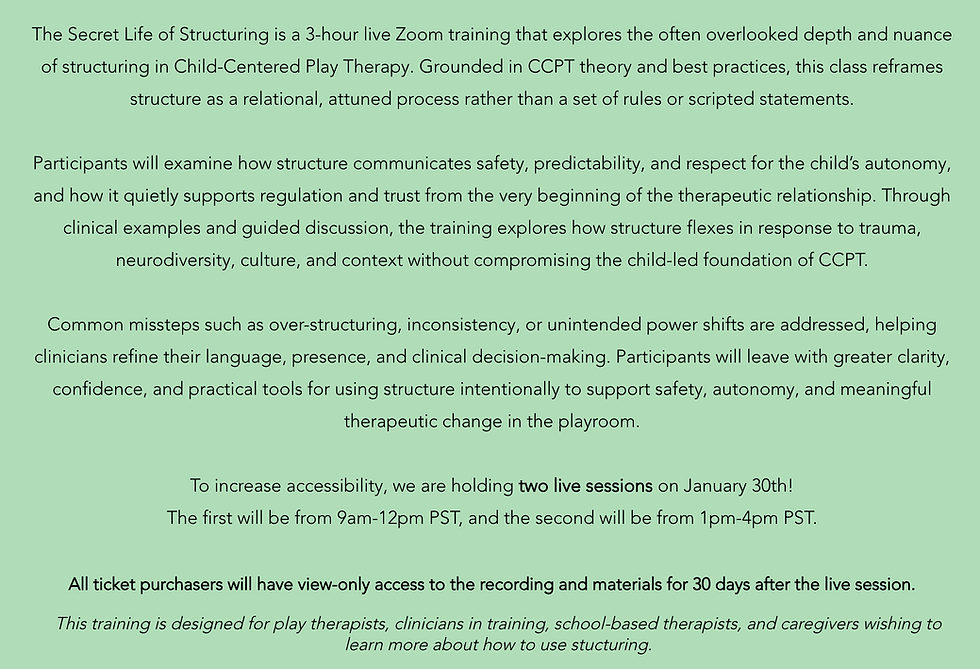
Structuring: The Unsung Hero of Child Centered Play Therapy
When we think about play therapy, imaginative play is what most often comes to mind. But beneath the surface, there is another skill quietly holding everything together: Structuring.
Structuring is often misunderstood, under-taught, or treated as a brief opening script rather than a living part of the therapeutic relationship. In reality, structuring is one of the most powerful and protective skills we have in CCPT.
I think of it as the unsung hero of the playroom.

What is structuring?
Structuring in CCCPT is how play therapists communicate safety, predictability, and respect without controlling a child. This includes how we introduce the playroom, how we hold time, how we explain limits, how we transition in and out of sessions, and how consistently we show up in those moments.
Structuring communicates to a child that the playroom has boundaries, that they are safe inside them, they do not have to be managed and can focus on the important work of being a child who is trying to heal. It's not about control! For many children, especially those who have lived in chaos, inconsistency, or role reversal, this is a crucial intervention.
Why Structuring Is Often Overlooked
Because structuring does not feel active, this skill can be minimized. We might rush through our opening statements or soften limits out of fear of being directive. But structuring isn’t just logistical, it’s relational. Children notice inconsistency and feel every wobble within an unstable structure. When structure is unclear, children step in to create it themselves, often through control, testing, aggression, or withdrawal.
Structuring is quiet and when done well, nothing dramatic happens. It doesn’t contain many breakthrough moments or emotional peaks. What happens instead is regulation. Structuring is part of what sets play therapy apart from the unpredictability of the world.
Structuring as Relationship, Not Control
Structuring does not limit freedom, in CCPT the opposite is true. Clear, consistent structure creates freedom. When a child knows what will or will not happen and can depend on it, they can risk deeper play.
Structure is a promise that the therapist will respect the child’s nervous system and hold the framework so they can explore what really matters.
A Redwood Center Perspective
Predictable conditions help Redwood trees grow tall, but every once in a while, terrible storms and fires rip through the forest. Despite mass destruction, giant Redwoods remain because their interconnected system of underground roots holds their base together. A stable environment that allows flexibility without collapse. Structuring provides similar flexibility and resiliency in Child Centered Play Therapy.
These hidden roots may not be the tallest or most visible part of the trees. It may not be what people come to see when they visit California. But without it, nothing else stands.

January 2026: The Redwood Center for Children and Families will be focusing on Structuring.
This month, structuring will be the theme on The Redwood Center for Children channels across all platforms (Tik Tok, Instagram, Facebook, YouTube) at @redwoodcenterforchildren.
We will be talking about:
· What structuring really looks like in practice
· common mistakes and misunderstandings
· how structuring supports reflection rather than competing with it
· Why limits, transitions, and consistency are acts of empathy
· How structuring protects both the child and the therapist
· How structuring can help parents at home.
Structuring is a promise that we can keep to children – adults will stay in their developmental lane so that children can stay in theirs. When it is done well, children feel it long before they can name it.
I'm looking forward to a year full of learning and growing alongside my community, and most importantly, continuing to advocate for the dignity and feedom of children everywhere.
Take care,
Jen

I love this! Reading this made me realize that I soften and minimize the structure part of my sessions sometimes out of fear of being too direct. I appreciate you so much!
This is wonderful! Loved how you "structured" this article. 😉✌️😬